 English▼



- 메일 주소 : David@tmaxcn.com
- 메일 주소 : Davidtmaxcn@gmail.com
- : No. 39, Xinchang Road, Xinyang, Haicang Dist., Xiamen, Fujian, China (Mainland)
블로그
Triple Roll Mill
June 23,2026.
Xiamen Tmax Battery Equipments Limited was set up as a manufacturer in 1995, dealing with lithium battery equipments, technology, etc. We have total manufacturing facilities of around 200000 square foot and more than 230 staff. Owning a group of experie-nced engineers and staffs, we can bring you not only reliable products and technology, but also excellent services and real value you will expect and enjoy.
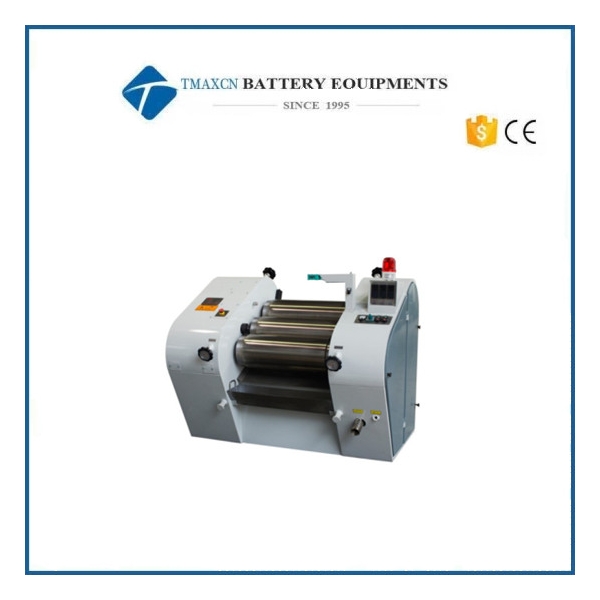
A triple roll mill is a mechanical device used to refine, disperse, or homogenize materials by passing them through three horizontally mounted rollers that rotate at different speeds. This process reduces particle size, improves consistency, and enhances the quality of the material being processed. Triple roll mills are widely used in industries such as chemical processing, pharmaceuticals, cosmetics, printing ink manufacturing, food production, and more.
In this article, we will explore the working principle, types, applications, advantages, and limitations of triple roll mills.
●What Is a Triple Roll Mill?
A triple roll mill consists of three horizontal rollers arranged in a triangular configuration. The rollers rotate at varying speeds (e.g., 1:3:9 ratio) to create shear forces that break down particles and mix components uniformly. The material is fed into the mill, where it is subjected to compression, friction, and shear between the rollers, resulting in finer particle size and improved dispersion.
●Working Principle of a Triple Roll Mill
1. Material Feeding
The raw material is introduced into the mill through a hopper or feed mechanism.
2. Compression and Shearing
As the material passes between the first two rollers, it undergoes compression and shearing due to the difference in roller speeds.
The gap between the rollers can be adjusted to control the degree of refinement.
3. Dispersion and Homogenization
The material then moves to the third roller, where further shearing and mixing occur, ensuring uniform particle distribution.
4. Output Collection
The refined material exits the mill and is collected for further processing or packaging.
●Types of Triple Roll Mills
1. LaboratoryScale Triple Roll Mills
Designed for smallscale testing and development work.
Typically handles batch sizes ranging from a few grams to several kilograms.
2. PilotScale Triple Roll Mills
Intermediatesized mills for scaling up processes from lab to production.
Suitable for mediumsized batches.
3. IndustrialScale Triple Roll Mills
Largecapacity mills used in fullscale manufacturing operations.
Capable of handling high volumes with consistent results.
4. Customizable Triple Roll Mills
Tailored designs for specific applications, such as temperaturecontrolled mills for heatsensitive materials.
●Applications of Triple Roll Mills
1. Chemical Industry
Production of pigments, dyes, and coatings.
Ensures uniform dispersion and fine particle size for enhanced product performance.
2. Pharmaceuticals
Manufacturing of ointments, creams, and suspensions.
Improves drug stability and bioavailability.
3. Cosmetics
Formulation of lotions, makeup, and skincare products.
Achieves smooth texture and even color distribution.
4. Food Processing
Preparation of chocolate, peanut butter, and other spreads.
Enhances flavor, texture, and shelf life.
5. Printing Inks
Production of highquality inks for various printing techniques.
Ensures consistent color and print quality.
6. Plastics and Polymers
Dispersion of additives, fillers, and stabilizers in polymer matrices.
Improves material properties like strength and flexibility.
7. Ceramics and Glass
Refinement of ceramic slurries and glass pastes.
Achieves uniform particle size and enhances product durability.
●Advantages of Triple Roll Mills
1. Particle Size Reduction
Effectively reduces particle size while maintaining uniformity.
2. High Shear Forces
Creates intense shear forces for efficient mixing and dispersion.
3. Consistent Quality
Produces consistent results across batches, ensuring product reliability.
4. Versatility
Suitable for a wide range of materials, including viscous pastes and semisolids.
5. Compact Design
Compact and easy to integrate into existing production lines.
6. Easy Maintenance
Simple design allows for easy cleaning and maintenance.
●Limitations of Triple Roll Mills
1. Batch Processing
Primarily designed for batch processing, which may limit throughput in continuous operations.
2. Heat Generation
Friction between rollers can generate heat, potentially affecting heatsensitive materials.
3. Material Constraints
Not suitable for extremely hard or abrasive materials, as they may damage the rollers.
4. Initial Cost
Highquality industrialscale mills can be expensive, especially for custom designs.
5. Skill Requirement
Operators need training to adjust settings and optimize performance.
●Key Features to Consider When Choosing a Triple Roll Mill
1. Roller Material
Common materials include stainless steel, carbon steel, and ceramic.
Choose based on material compatibility and desired wear resistance.
2. Roller Speed Ratio
Standard ratios (e.g., 1:3:9) provide optimal shear forces.
Custom ratios may be required for specialized applications.
3. Gap Adjustment
Adjustable gaps allow precise control over particle size and consistency.
4. Temperature Control
Integrated cooling systems help manage heat during processing.
5. Capacity
Select a mill with appropriate capacity for your production needs.
6. Safety Features
Look for safety interlocks, emergency stops, and protective guards.
●Examples of Triple Roll Mill Manufacturers and Pricing
| Manufacturer | Type | Price Range (USD) |
||||
| Charles Ross & Son Company | Industrialscale mills | $10,000 – $50,000+ |
| Munson Machinery | Pilotscale mills | $5,000 – $20,000 |
| Buhler Group | Customizable mills | $20,000 – $100,000+ |
| De Dietrich Process Systems | Laboratoryscale mills | $2,000 – $10,000 |
●Tips for Maximizing Triple Roll Mill Performance
1. PreMixing
Premix materials thoroughly before feeding them into the mill to ensure even processing.
2. Regular Maintenance
Clean and inspect rollers regularly to prevent contamination and maintain efficiency.
3. Optimize Settings
Adjust roller speed, gap, and feed rate based on material properties and desired outcomes.
4. Monitor Temperature
Use cooling systems or ambient controls to manage heat during prolonged operation.
5. Train Operators
Provide adequate training to operators for safe and effective use of the equipment.
●Conclusion
Triple roll mills are essential tools for refining, dispersing, and homogenizing materials across various industries. Their ability to produce consistent results with fine particle size makes them indispensable in applications requiring highquality output. While they have certain limitations, ongoing advancements in design and technology continue to enhance their capabilities and address existing challenges.
What aspects of triple roll mills do you find most interesting? Share your thoughts below! Together, let’s explore how these powerful machines can improve material processing and innovation.
 +86 13174506016
 David@tmaxcn.com

